
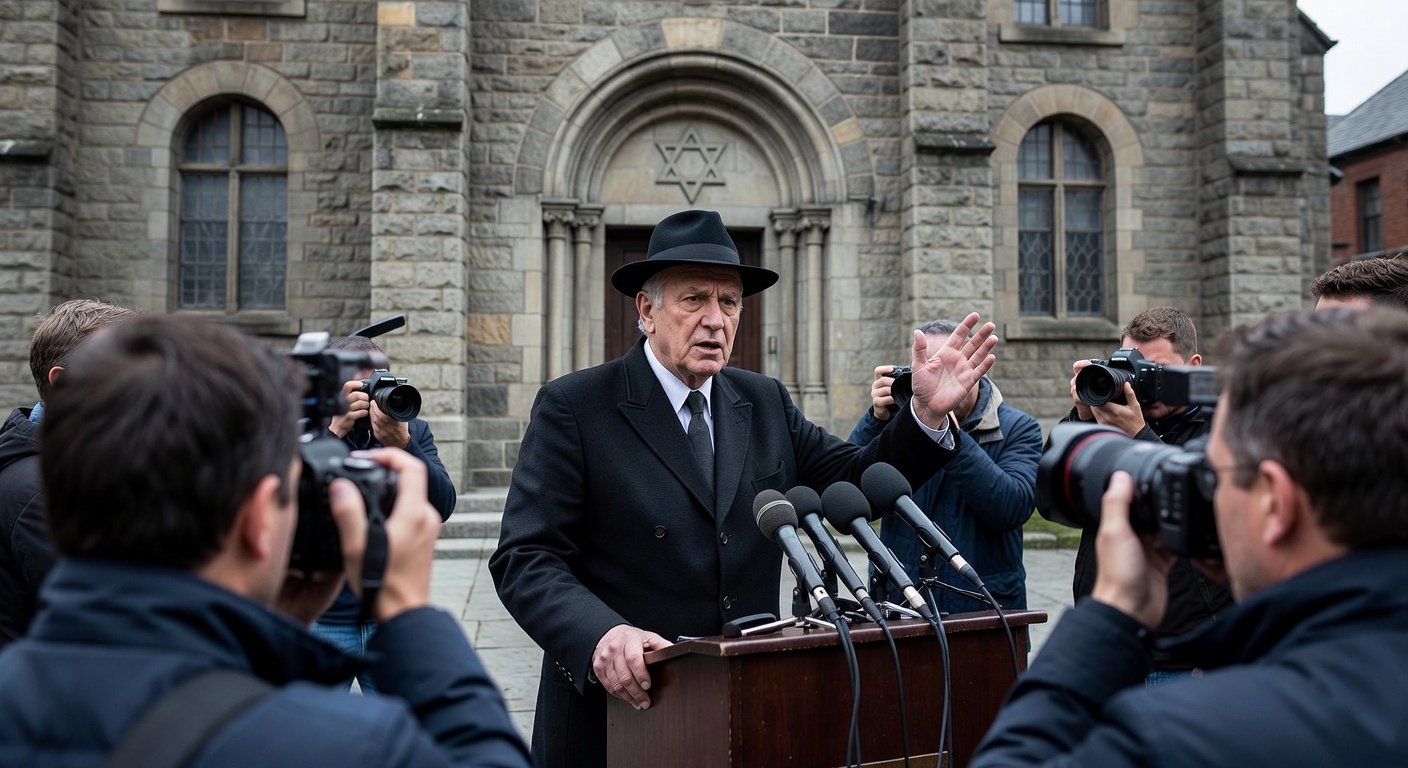
A bottle filled with accelerant shattered a window at Kenton United Synagogue in Harrow, north-west London, overnight on April 18-19, 2026, igniting minor smoke damage in the medical room.
No one was injured in the arson attack, but the incident sent shockwaves through the local Jewish community. Counter-terrorism police launched an investigation, classifying it as an antisemitic hate crime.
This marks the third assault on Jewish sites in London within a week. On Wednesday, attackers attempted arson at Finchley Reform Synagogue. Friday saw a similar attempt at the Jewish Futures building in Hendon.
Sir Ephraim Mirvis, the UK's Chief Rabbi, responded swiftly from his office, declaring the attacks signal a dangerous escalation.
Police confirmed an Iran-linked group, Ashab al-Yamin, claimed responsibility online for the Kenton attack. Officers increased patrols across north-west London boroughs including Harrow, Barnet, and Brent, with visible policing bolstered at synagogues and Jewish centers.
Detective Chief Superintendent Richard Smith of the Metropolitan Police Counter Terrorism Command told reporters outside the synagogue that forensics teams combed the scene for evidence, including fragments of the bottle and accelerant residue.
We are treating this as part of a series of hate crimes. Our priority is community safety and bringing those responsible to justice. Detective Chief Superintendent Richard Smith, Metropolitan Police Counter Terrorism Command
Earlier incidents fit a pattern: the Finchley attempt involved a device thrown at the building's entrance, causing no fire but prompting evacuations. In Hendon, smoke was reported from a targeted door, extinguished quickly by responders.
A March 23 attack in Golders Green adds to concerns of a broader trend. Community leaders note rising tensions amid global events.
Prime Minister Keir Starmer condemned the violence from Downing Street, vowing zero tolerance.
London Mayor Sadiq Khan echoed the sentiment during a press briefing, announcing extra funding for community security. He described the attacks as "cowardly attempts to instill fear."
Rabbi David Mason, who leads Kenton United Synagogue, addressed congregants at a morning service. He praised the rapid response from fire crews, who contained the blaze within minutes.
Shomrim, a Jewish volunteer neighborhood watch group, reported heightened vigilance. Patrols doubled in the area since Friday, with volunteers coordinating with police via radio.
- April 16: Attempted arson at Finchley Reform Synagogue.
- April 18: Jewish Futures building in Hendon targeted.
- April 18-19: Kenton United Synagogue arson attack.
- March 23: Golders Green incident.
Security expert Dr. Rachel Harris from the Institute for Jewish Policy Research analyzed the pattern for broadcasters. She pointed to online claims by Ashab al-Yamin, a fringe group tied to Iranian networks, as evidence of external influence.
Community members gathered outside the synagogue by midday, laying flowers and lighting candles. One attendee, Esther Levy, a 62-year-old local resident, spoke of defiance. "We've faced this before, but we won't be driven out of our home," she said. Esther Levy, local resident.
Authorities urged the public to report suspicious activity via the anti-terrorism hotline. The Community Security Trust, which tracks antisemitic incidents, reported a 40% uptick in the UK over the past year, though exact figures for 2026 remain preliminary.
As investigations continue, Jewish leaders called for unity. Sir Ephraim Mirvis scheduled talks with government officials, pressing for enhanced protections amid what he termed an "unprecedented" wave.