

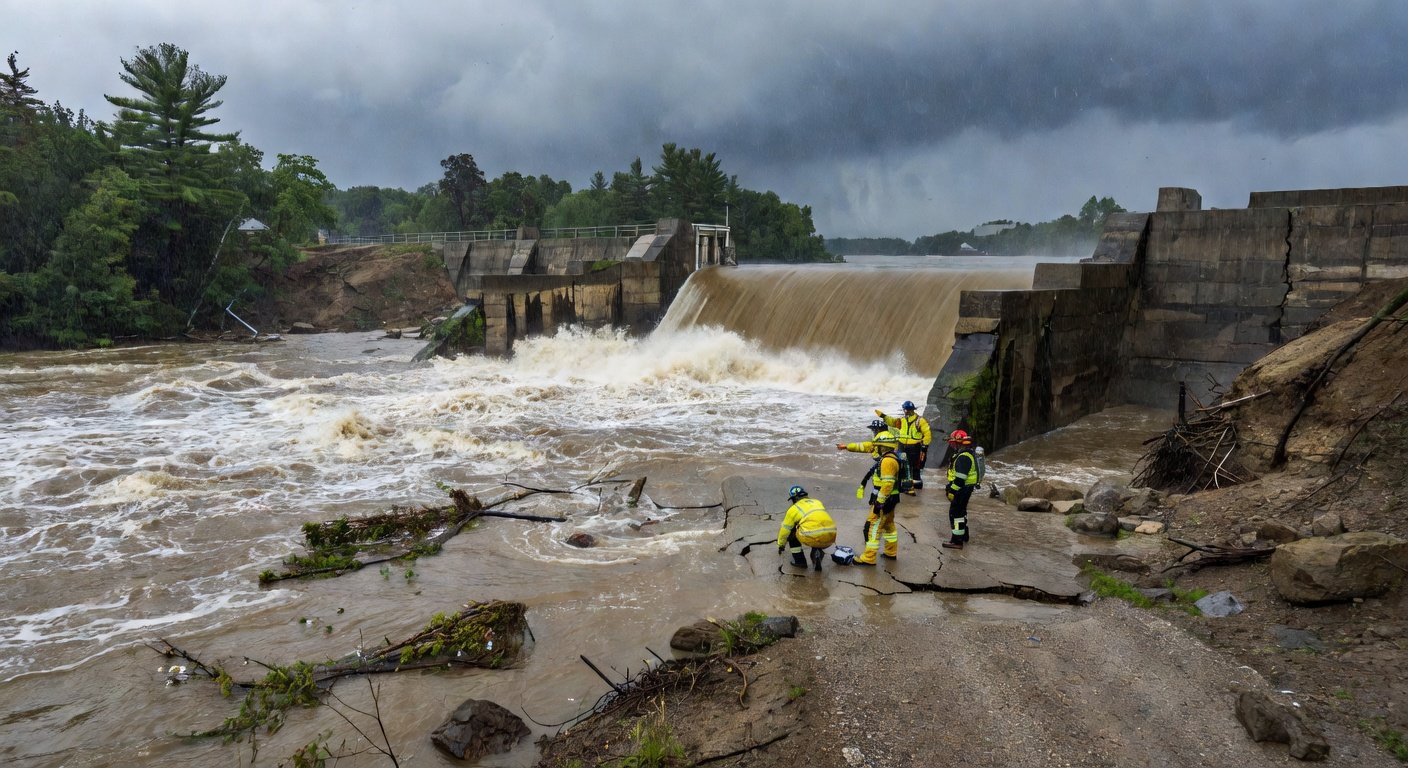
Rain-swollen rivers surged through northern Michigan on April 18, 2026, placing the Cheboygan Lock and Dam Complex perilously close to failure and trapping drivers in flooded streets statewide.
Water levels at the dam stood at 7.08 inches below the top by 1:30 p.m., a slight rise of 0.24 inches from morning readings after an overnight drop to 7.32 inches, according to Michigan State Police Emergency Management and Homeland Security Division updates. The facility on the Cheboygan River, which feeds into Lake Huron, has drawn intense scrutiny as spring storms compound earlier record snowfall melt.
Governor Gretchen Whitmer declared a state of emergency on April 10 for rising waters across multiple counties, activating the State Emergency Operations Center in Lansing. The order addressed widespread inundation from Black Lake and the Cheboygan River, where flows now exceed 4,800 cubic feet per second.
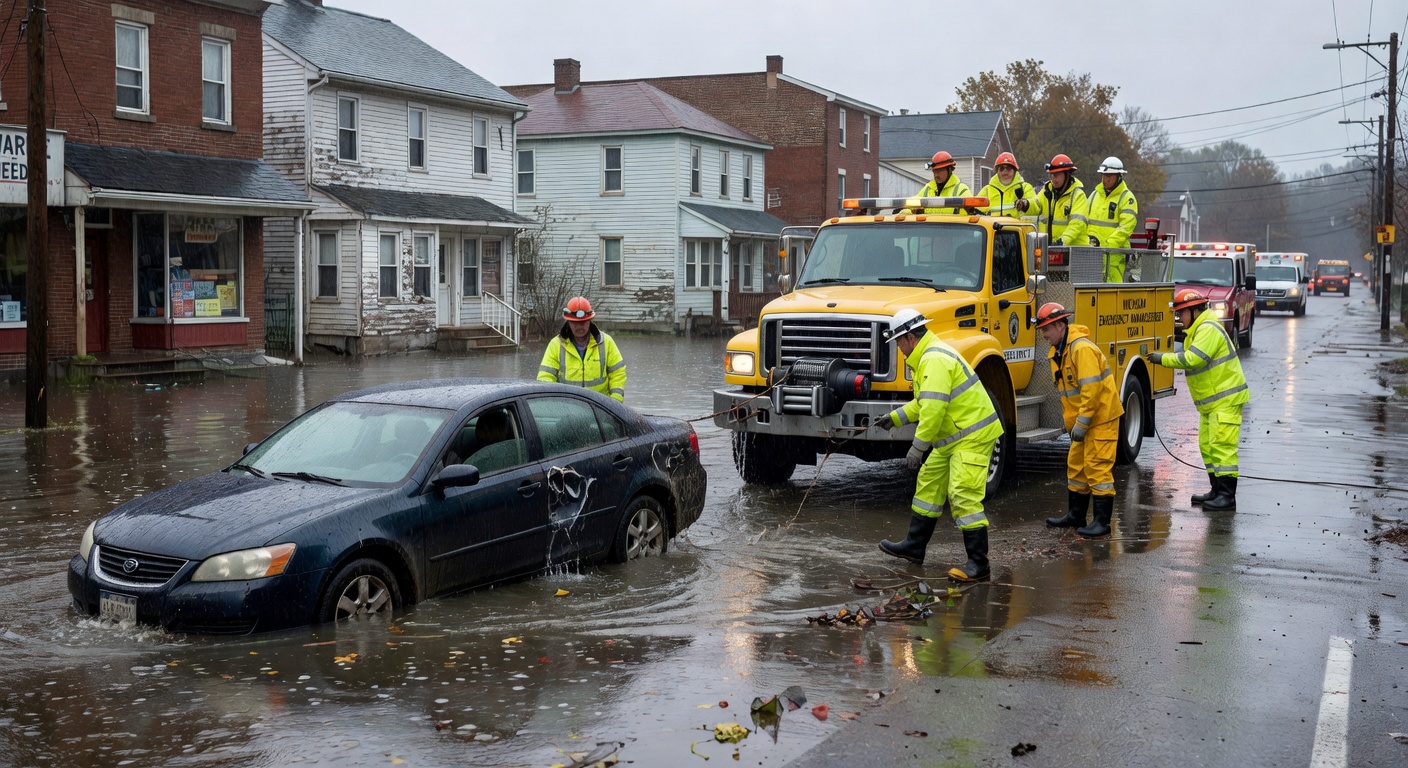
In Cheboygan, a city of 4,800 residents, streets turned into rivers overnight, stranding vehicles and prompting swift-water rescues. Local resident Vicki Alexander watched the torrent from her home near the riverbank.
HydroMine Cheboygan LLC, which operates the hydroelectric facility, restarted its turbine on April 17, boosting outflow by 30% to 2,000 cubic feet per second. Roy Davis, head of the company, inspected the site early Friday.
Bridge Michigan reporter Kelly Pearce, covering the region from Traverse City, noted fluctuating levels tied to upstream releases from Black Lake. "The dam's earthen sections are the weak point," Pearce said in a phone interview. "Engineers are monitoring seepage around the clock."
Detroit Free Press environment writer Keith Matheny reported from the scene that federal assistance could arrive if levels climb another inch. "National Weather Service forecasts more rain through Sunday," Matheny said. "That could push us over the edge."
Michigan State Police EMHS Captain Rebecca Bahner, coordinating from the operations center, outlined evacuation plans for low-lying areas. "We're staging pumps and heavy equipment along the river," Bahner said. "Residents within 1,000 feet of the dam should have go-bags ready."
Flooding extends beyond Cheboygan. In Oakland County south of Detroit, 15 roads closed Friday after 4 inches of rain since Thursday. Grand Rapids saw 200 basements flooded, with firefighters responding to 50 calls by noon. The Great Lakes region, already saturated from winter's 120 inches of snow in some spots, offers little absorption.
Cheboygan County Emergency Manager Troy DenHouter addressed a crowd at a briefing Thursday night. "We've doubled spillway gates to maximum capacity," DenHouter said. "But nature doesn't always cooperate." He pointed to sonar scans showing no major structural cracks yet.
U.S. Army Corps of Engineers hydraulic engineer Dr. Lena Vasquez joined remotely from Detroit. "Water velocity is at 8 feet per second—near the design limit," Vasquez explained. "We're advising against any boating on the river until flows drop below 3,500 cfs."
Local business owner Mike Thibault shuttered his riverside bait shop on April 17. "Lost $5,000 in inventory to seepage already," Thibault said. "If that dam goes, it's game over for downtown." Insurance claims from prior floods still pend, he added.
Federal Emergency Management Agency regional director Sarah Kline activated liaisons in Michigan on April 18. "President's major disaster declaration is under review," Kline stated in a Lansing presser. "Preliminary aid could total $20 million if damages mount."
Meteorologist John Morales at the National Weather Service Detroit office tracked the system. "A stalled front keeps dumping 1-2 inches daily through April 21," Morales predicted. "Cheboygan could see 6 more inches total."
Residents like Alexander prepare for the worst. Schools closed Friday in Cheboygan, Mackinaw City, and surrounding townships. The Michigan Department of Transportation detoured U.S. 23 north of Mackinac Bridge after washouts.

Historical precedent weighs heavy. The 1986 Cheboygan flood breached a similar structure, displacing 500 families and causing $15 million in damage—equivalent to $40 million today. Engineers reinforced the dam in 1998, but recent inspections flagged aging spillways.
Governor Whitmer planned a Saturday flyover, her office confirmed. State Rep. John Roth, R-Cheboygan, urged federal intervention. "This isn't just local—it's a Great Lakes threat," Roth said on local radio.
As night fell on April 18, floodlights illuminated the dam's crest. Water roared through gates, inches from the brink. Emergency sirens stayed silent, but tension gripped the river town.